A Better Way to Slice an Onion
Learn three practical onion cuts, from wide wedges for the oven to thin rings for a sandwich, with a stable setup and clear cues for each.
8 min read
Half an onion can take five minutes to cut and another ten to cook, but those fifteen minutes may do more for dinner than the ingredients added later. Long slices soften into a sweet tangle alongside sausages. Small dice mostly disappear into a pot of lentils. A few rings give a thick sandwich enough crunch to keep it interesting. The recipe may simply say sliced onion, leaving you to decide whether it should fall apart or hold its shape. That decision belongs at the cutting board.
Begin with a firm onion and a board that stays still. A damp kitchen towel under the board works when a slick counter gives you trouble. Clear the immediate area so there is room for the whole blade and a place to put the finished pieces. A medium onion and a sharp chef’s knife are enough to practice everything here. Set up in good light so you can see the difference between the dry outer skin and the thin first layer underneath.
Find the two ends
At one end of a whole onion, there is a rough root plate and sometimes a few stiff strands. The other end is the tip where the dried stem and neck come together. Cut the stem tip off to make a flat face, set the onion on that face, and divide it lengthwise through the root. Both halves can now rest on their cut sides. Peel off the papery skin. An onion with a leathery outer layer can lose that first layer as well, especially if you are serving it raw.
Keep the root intact while making a first set of cuts if you want the layers to stay together. Trim the dry root off before cooking. It is woody and gives a different texture from the layers around it. For wedge cuts, the very base of the core can stay in temporarily to hold the layers together, but remove any dry strands or dirt before cooking. A cut just above the root plate gives most of the structure without carrying much of the tough end into the dish.
A flat base is the main safety advantage. You can make tidy pieces without pressing hard or trying to keep a slippery globe from rolling. If the last little fragment is too small to hold comfortably, set it aside for stock or cook it in a larger piece. A perfectly tidy pile of onion is worth very little if making it requires a few rushed cuts beside your fingertips.
Slice along the length for a tangle
Lay one half flat, with the root pointed away from you. Think of the onion as a set of lines running from root to stem. For long slices that hold together during cooking, begin near the edge and cut along those lines. The outside layers curve, so the blade can angle in toward the middle at first, then stand almost vertical as you reach the center. Turn the onion around if you find yourself cutting at an angle that feels awkward. There is no need to complete both sides with the same hand position.
A thickness of about a quarter inch suits onions going into a skillet with sliced peppers. The pieces soften at the edges while retaining enough structure to lift with a fork. Thin slices take less time and are more likely to melt together. Thicker ones brown in patches and stay noticeably juicy. If a recipe calls for half an onion and the onion is unusually large, cut only what you need. More onion changes the way a skillet cooks because the extra pieces release more moisture.
To practice, slice one half lengthwise and cook it over medium heat with a thin coat of oil and a pinch of salt. Stir once the bottom pieces become glossy. As the onion softens, notice that the strips still have a discernible length. This is useful when the onion will share a plate with sausages, mushrooms, or wedges of pepper. Take it off the heat when the strips have softened and developed the amount of color you want. Dinner does not always need deeply browned onions.
Cut across for arcs and rings
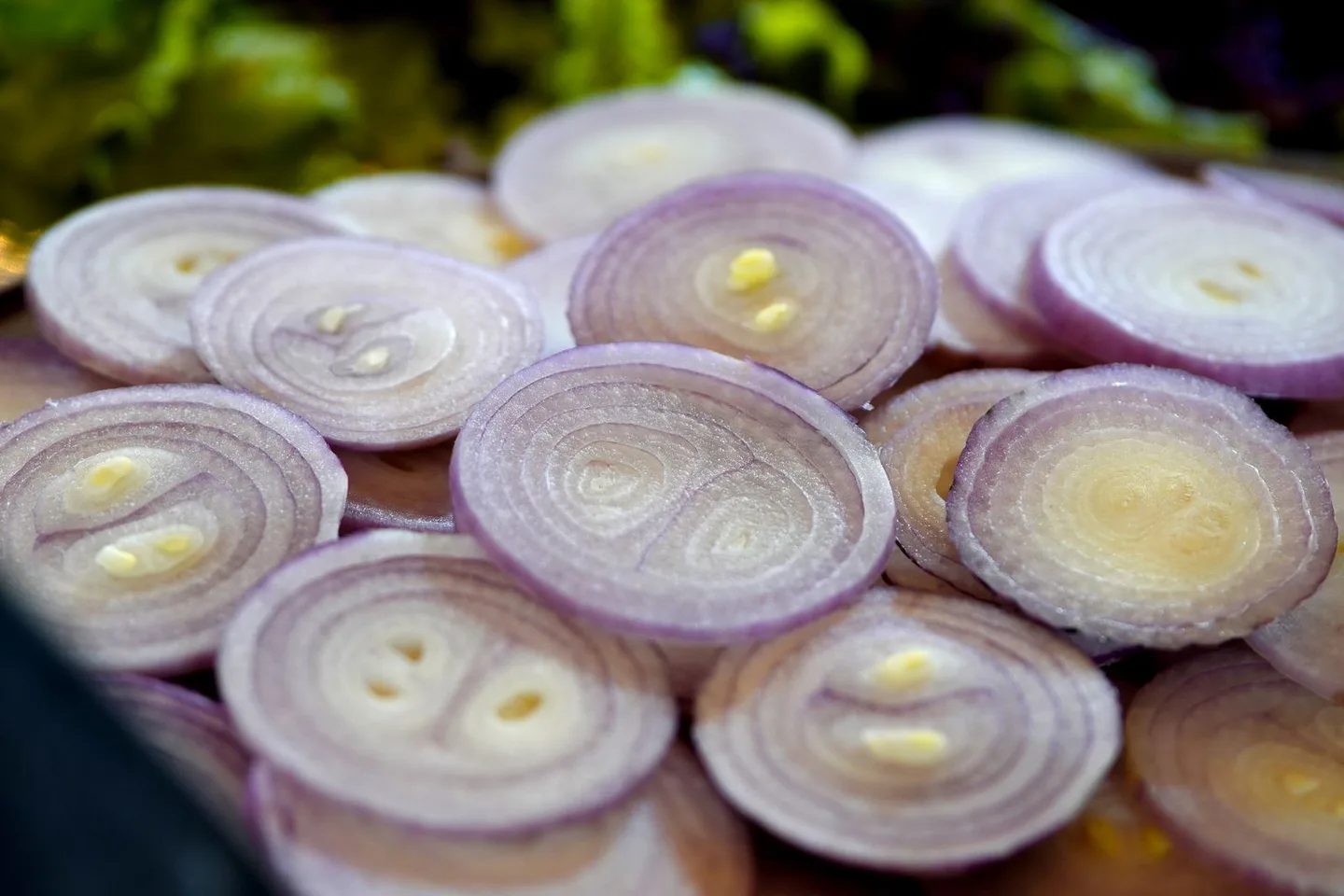
For half moons, start with another peeled half on its flat side. Turn it so the root points to one side. Cut across the onion rather than toward the root. The cuts release nested arcs. Separate them with your fingers once the knife is down. Thick arcs are good on a tray of vegetables. Thin arcs fit into a sandwich and mix easily through a salad. If you plan to sauté them, give them enough room to release their moisture before they begin to brown.
Whole rings are attractive on a burger and useful when the onion will be quick pickled. A whole onion rolls as you cut it, so first slice a narrow strip off one side to give it a little platform. Place it on that flat strip and cut through from the stem end across the width. Separate the rings gently after cutting. The side you trimmed leaves a small break in the outermost rings. On a sandwich that makes them easier to bite. If you are uncomfortable with the shape, make half moons. The finished sandwich will still have plenty of onion in every bite.
For raw red onion, cut a few extra arcs and taste one. If it feels too sharp for the dish, rinse the slices briefly in cold water, drain, and pat dry. A cold water soak of a few minutes also softens the punch of many onions. Drain thoroughly before adding the slices to a dressed salad. A little clinging water may be harmless on a burger and enough to dilute a carefully adjusted dressing in a small bowl.
Make dice without forcing the knife
An onion has its own layers, which do much of the work in a small dice. Lay the half flat and use the root end to keep it together. Make a series of lengthwise cuts from the stem side toward the root. Stop short of the plate so the cuts remain attached at one end. Then turn the onion and cut across those slices. A more closely spaced first set of cuts makes smaller pieces. Keep your guiding fingertips tucked back and reposition them whenever you need to. The knife should move easily through the layers.
Many demonstrations add a horizontal cut parallel to the board. It can make a very even professional dice in experienced hands. At home, it is possible to make a small enough dice for soups and sauces without it. Let the natural layers separate, and recut any broad pieces that remain. This is particularly practical near the outer edge, where wide flat pieces are more likely to survive the first cuts. There is no advantage in trying to run the blade sideways under a hand pressed on a slippery onion.
Aim for an even size across the handful you will cook together. A few larger pieces are easy to chop again. Very fine pieces scattered through a coarse dice may color and stick before their neighbors begin to soften. For a batch of beans, roughly even pieces the size of a small pea are often a sensible aim. For a raw garnish, chop a spoonful a bit finer once the pieces are already flat. Small differences are barely visible once the onion is cooked into a sauce.
Leave wide wedges for the oven
On a roasting tray, very thin onion tips can blacken before the thicker layers turn sweet. Larger wedges offer better control. Cut each peeled half into three or four sections running from stem to root. Leave a small connection at the core so the layers hold. Rub oil over their cut faces and spread them with space between pieces. Place a flat face in contact with the tray. Turn each wedge once the first side has taken on some color, lifting underneath with a broad spatula.
Wedges are especially useful when onions share a tray with peppers, chunks of squash, or sausages. Their larger size helps them keep pace with ingredients that take time to soften. A fork inserted near the middle tells you more about doneness than a look at the tips, which brown quickly. If a few thin outside layers color early, pull them out with tongs and let the rest go on. Those little browned pieces make a good topping. For a skewer, choose pieces of comparable size and thread through several layers so the onion holds securely.
Another use for wedges is in a pan of vegetables that will be simmered afterward. Let the broad faces brown and transfer the wedges to the pot. They will soften slowly and give the broth a more rounded flavor. For a clear broth, use a cut large enough to lift out at the end. For a chunky stew, cut off the root plate and give the wedge a slight squeeze after browning so the leaves loosen as it cooks.
Try two cuts in the same pan
Slice one half along the length and the other across it. Cook small portions side by side with a little oil. Keep the thickness similar and notice which pile stays in long strands and which falls into short arcs. Add the rest of the slices when you have seen the difference. Both cuts will be good in a frittata or folded into cooked lentils. If you need to cool cooked food for later, use a shallow container and refrigerate it promptly.
The experiment is more useful than memorizing terms. When you want visible onion in a tray of vegetables, you will reach for the wedge. When the onion should sweeten the base of a sauce, you will cut small pieces that soften quickly. When you want to feel it in a sandwich, you will trim a little half and cut two or three thin arcs. Leave time to set up the board, give yourself a stable piece to work on, and make the shape that fits the dish.