How to Read a Produce Market Before Buying a Thing
The route, the signs and the small transactions at a produce market tell you almost as much as the displays. Make one empty-handed circuit before you fill a bag.
8 min read
At a produce market, the first visible tomatoes are rarely the most useful ones. They are the ones you can see from the entrance, which is a different distinction. You are also carrying an empty bag and perhaps a list that says nothing more specific than tomatoes. Those three facts explain a surprising number of purchases. Try walking past the first display without deciding anything. The same tomatoes may still be the right ones after you have seen the stalls farther back, compared the prices and figured out what you are actually cooking. It is easier to learn about a market when your first decision can wait.
A market with twenty produce stalls and a row of bakeries can feel designed to make you hurry. At smaller places the pressure works differently. Everyone else seems to know the routine, the best place to stand and whether to reach for a peach. In either setting, a slow first pass helps. There is no particular prize for looking like a regular. The habits that regulars have learned are mostly small, visible and worth observing in their own right.
Find the point where people stop
Before comparing vegetables, notice how transactions begin. At one stall, shoppers take a basket, fill it and hand it to the cashier. At the next, they stand in a loose queue while a seller chooses and weighs every item. A low shelf at elbow height often invites people to reach, while a raised display with fruit tilted forward can serve as a window. Neither is a rule. The clearest guide is the person who bought something just before you.
Wait behind the active shopper until you understand the pattern. Blocking a stall while comparing every type of lettuce makes the seller do traffic management as well as sell lettuce. If you are still deciding, stand a few feet back. At a busy stall a brief question like “Do I choose these or will you?” settles the matter quickly. When you are choosing your own fruit, move it as little as possible. Test firmness with the lightest useful touch and never push a thumb into flesh to see whether it yields. The next person will buy the mark you leave.
How the stall is stocked also matters. An open tray of bruised pears may be the place to look for a bargain if you are making a compote that afternoon. It would be a poor place to shop for fruit you need to carry across town and offer whole tomorrow. An orderly grid of pears facing in one direction can be beautiful, but it tells you more about the stallholder's display than about how the fruit tastes.
Read the whole sign
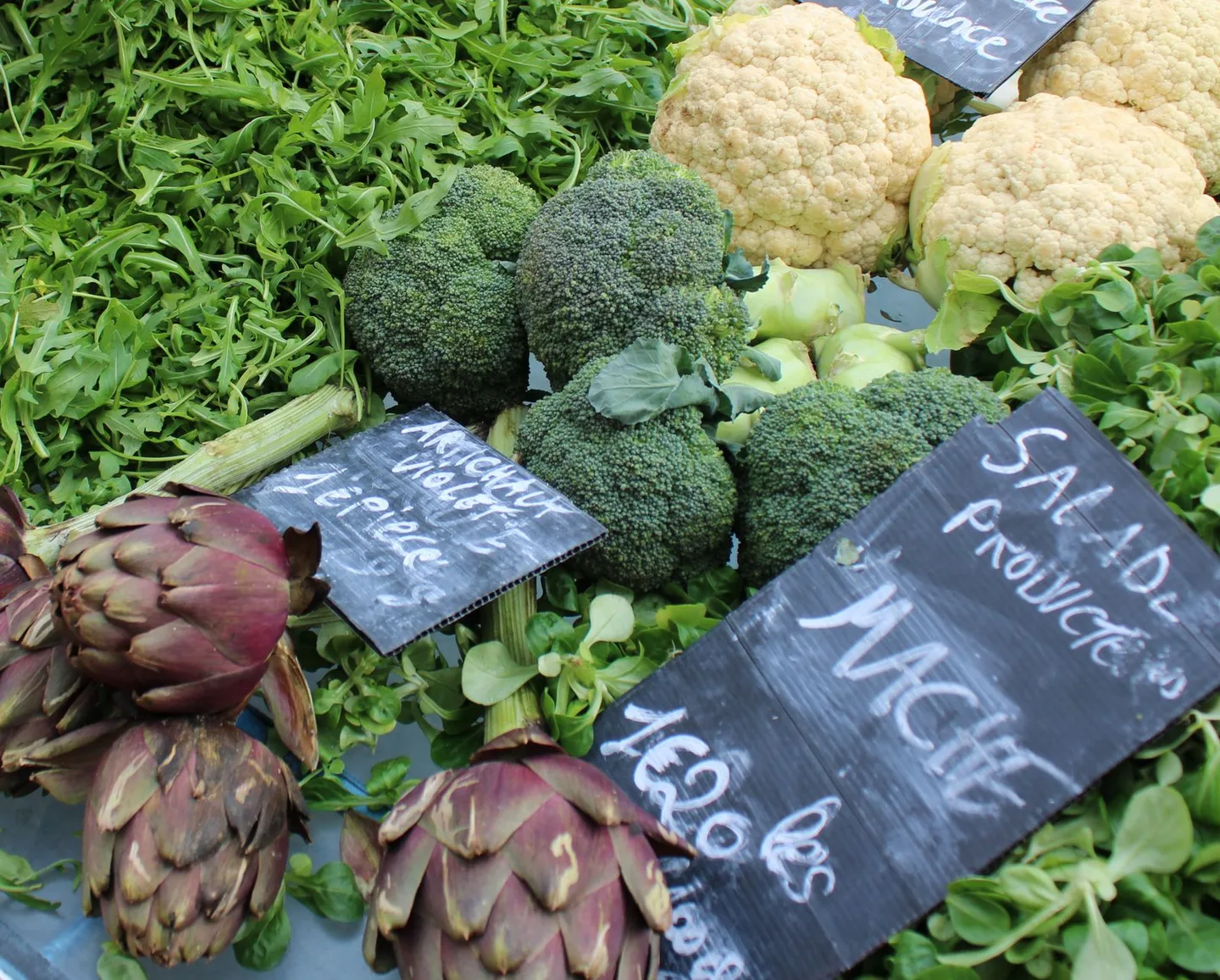
Signs tend to give you enough information to do quick arithmetic, provided you read the little writing. Check whether a price is per piece, weight, bunch or basket. A slightly smaller basket can be more expensive by weight even when the sign over it has a lower number. For greens, look at the amount that is edible. A heavy bunch with long, tired stems may yield less for the stove than a compact, well-trimmed one. If you will use those stems in a stock or chop them into a stew, your calculation changes again.
A sign with a farm name, region or variety can tell you something useful, but those details answer different questions. A farm name may indicate who grew the produce, while a region describes where it was grown. A named variety hints at likely texture, flavor or use. Two stalls can carry the same variety from different sources, and two varieties from the same farm may cook quite differently. If you need fruit to ripen across several days, ask about readiness. A variety label by itself will not tell you when an individual plum is at its best.
Some markets are run as producer markets with rules about what vendors can resell. Others are neighborhood markets supplied through wholesalers as well as growers. Each kind can be a useful place to shop. To understand a market on its own terms, look for the market organizer's sign or ask where the vendor's goods come from. “Did you grow these?” is a reasonable question when asked in a friendly tone and at a moment when the seller can answer. You may find that the people buying from both growers and wholesalers do so for reasons that have little to do with the slogans on any sign. They need several quantities at several price points, or a particular ingredient on a week when local supplies are low.
Make ripeness part of the order
Imagine that you want enough stone fruit for a dessert tomorrow and for snacks later in the week. Buying every piece at the same stage of ripeness puts you on a narrow timetable. Instead, ask for some that are ready soon and some that will hold a little longer. The seller may have trays at different stages or may point out differences within one basket. If you will be on a crowded bus for half an hour, mention it when you ask for ripe fruit. A very ripe peach that makes an excellent dessert may be difficult to get home intact beneath a bag of potatoes.
The intended use can be more useful to the seller than a demand for the “best” item. For a fresh salad, the crunch of a cucumber and the tenderness of its skin are helpful. For a cooked dish, a large cucumber can be serviceable after you remove a tough skin or a loose center. For roasted tomatoes, ask about ones that soften into a concentrated sauce rather than releasing a great puddle of water. A market conversation becomes practical when both people have the same dish in mind.
Try asking one question that you can verify later. “Which one would hold its shape when roasted?” is more useful than “Is it good?” At home, make a note of which variety you used and whether it behaved the way you hoped. The record can be as simple as a word on a shopping list. A market is an unusually forgiving place to learn in small increments because you can buy a single pear or just enough peppers for one supper, if the seller's pricing allows it.
Look past the produce
The produce stalls are usually only part of what makes a market a market. A knife sharpener, baker, flower seller or small grocery can alter its pace and the reasons people come. Watching where someone takes a bag after buying a bunch of herbs can show how the market fits into a household's shopping. Some people come for one ingredient and leave. Others collect a handful of things for a meal. A market with tables, shade and a place to pause invites a different visit from one set up on a narrow pavement where buyers need to keep moving.
It is tempting to turn those differences into judgments about which market is more authentic. A better question is what each one makes possible for the people who use it. A quick stall with clearly posted prices is particularly convenient on the way home from work. A place where sellers have time to talk is helpful when you need a recommendation or want to learn about a crop you rarely see. Neither depends on how many visitors pause to take a photograph. If you take pictures, ask first when people, a private workspace or an identifiable stall will be the subject. It is easier to photograph the tomatoes you have paid for once you get home.
Weather and time change the view. Late in the day, a stall may have fewer kinds of produce or more willingness to sell a larger quantity. A discount is never guaranteed, and some vendors have other plans for their remaining stock. An early visit is better when you need a specific herb or a large quantity of the same item. A later visit can suit a flexible cook who sees half a box of peppers as the beginning of tomorrow's lunch.
Build a small route of your own
On the second circuit, buy the heavy items first if that helps you pack, or buy them last if you would otherwise carry them around the entire market. Either way, keep a separate space for things that crush. A flat reusable container will protect ripe berries far better than a large tote. If you plan to buy chilled foods too, take an insulated bag and go home promptly afterward. Even the most appealing market lunch is less pleasant when it arrives bruised, warm or leaking into a loaf of bread.
Leave enough room in the plan for one decision that depends on the stalls. If a bunch of dill is particularly good, you can buy it without pretending that dinner needs six extra ingredients. Add it to potatoes, a yogurt sauce or a cucumber salad, and keep the other choices ordinary. When something turns out less successful, remember what you asked and what you could see. A peach that was wonderful at the stall and pulpy by the time you ate it may have been the right peach for a different day.
Your first circuit on the next visit will probably be shorter. You will remember who displays tender herbs in the shade, where the baskets hide their weight labels and who wants shoppers to queue on the far side. Those details are worth knowing even if you leave with exactly the tomatoes you could see from the entrance. You will understand why you chose them, and you will have an idea of where to look when a different meal calls for a different kind of tomato.